


Creating a good ending for an anime is one of the most difficult tasks for any series. Simply bringing the story to an end is not enough: it is necessary to tie together its main events, give the characters a coherent conclusion and, above all, create an emotional connection that stays with the viewer even after the credits roll.
This task becomes even more complicated when we consider the limitations of the industry. Tight deadlines, market decisions, changes in planning, and even the need to end a production earlier than expected can cause works with great potential to have disappointing endings. That is why, when we find an anime that manages to create a truly memorable ending, it is worth recognizing that achievement.
Today, we are going to talk about three unforgettable anime endings: Dragon Ball GT, Cowboy Bebop, and Your Lie in April. Each one takes a completely different approach, but all three manage to turn their final moments into something that remains in the audience's memory.
1. Dragon Ball GT — A Legacy’s Farewell

Dragon Ball GT is a series that still generates discussion among Dragon Ball fans. The series has faced criticism regarding its quality, narrative choices, and the way some characters were used. Even so, there is one aspect of GT that remains particularly memorable: its ending.
After following Goku for so many years, the final episode transforms his farewell into something much greater than simply the conclusion of a series. Goku stops being just the protagonist of an adventure and comes to represent the entire Dragon Ball journey and the relationship built between the character and his audience.
What makes this moment so powerful is precisely its sense of farewell. The story seems to recognize that this journey accompanied an entire generation and that, after so many battles, adventures, and challenges, it is finally time to move forward.
The use of the Dragon Ball GT opening theme during the ending reinforces this feeling even further. A song that the audience had already associated with the series takes on a new meaning in that moment, almost functioning as an emotional retrospective of everything that had been experienced.
It is important to point out that Dragon Ball GT is not simply the conclusion of Akira Toriyama’s entire work, as Toriyama had limited involvement in the production of the series. Even so, within the story presented by GT, the ending works as a symbolic farewell to Goku and to the era of Dragon Ball represented by the production.
Regardless of the criticism directed at the series, it is difficult to deny the emotional strength of this ending. Dragon Ball GT understands what Goku means to its audience and turns his farewell into a moment about legacy.
2. Cowboy Bebop — A Melancholic Ending
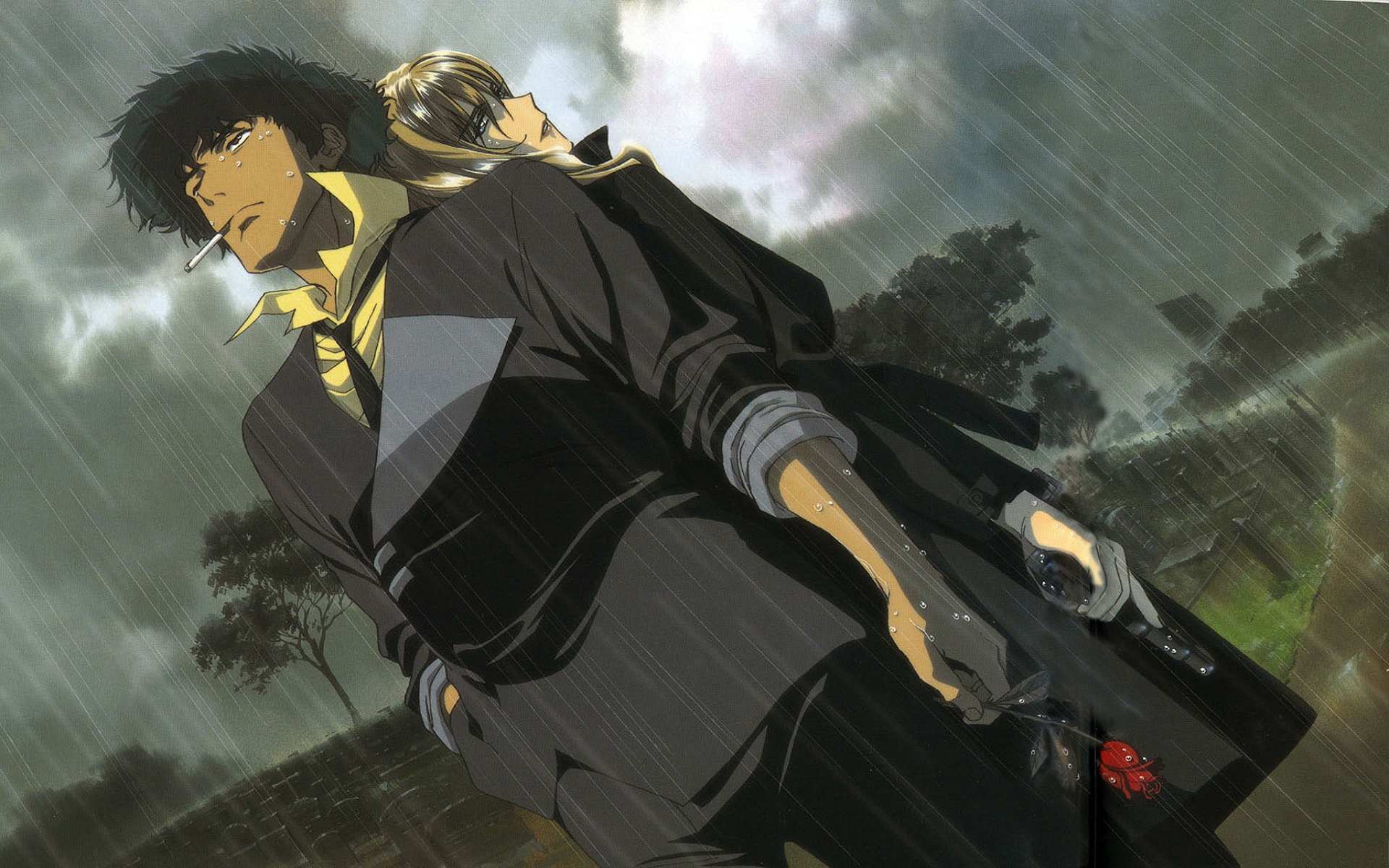
While Dragon Ball GT uses its ending to celebrate a journey, Cowboy Bebop takes a completely different path. Its conclusion is marked by melancholy, the past, and the inevitability of its characters’ choices.
Spike Spiegel spends much of the series trying to live in the present while carrying the problems of his past. As the story progresses, it becomes increasingly clear that he was never truly able to escape his old life.
In the end, Spike says goodbye to his crewmates and sets out to confront what he left behind. Jet, Faye, and the other characters also have their own problems and continue carrying their own stories, making it clear that not everything needs to be resolved for a narrative to have a meaningful conclusion.
It is precisely this characteristic that makes the ending of Cowboy Bebop so memorable. The series does not try to offer a perfect solution for every character. Instead, it focuses on Spike’s decision to finally confront his past.
The direction and animation also elevate the episode to another level. Some sequences have a visual quality that comes close to a cinematic production, using framing, lighting, and movement to transform the final confrontation into an extremely impactful visual experience.
And once again, the soundtrack plays a fundamental role. The music is not there simply to accompany the images: it helps build the emotional identity of the scene and makes the ending even harder to forget.
Cowboy Bebop shows that a good ending does not need to answer absolutely every question. Sometimes, all it takes is putting the character face-to-face with what they have spent the entire story trying to avoid.
3. Your Lie in April — A Painful and Beautiful Ending

Few anime manage to handle emotion as delicately as Your Lie in April. The series builds its narrative around music, friendship, trauma, and overcoming adversity, preparing the viewer for an ending that, although painful, remains consistent with everything the story had been building toward.
The ending of Your Lie in April works precisely because it does not try to turn an extremely difficult situation into something artificially happy. The story takes a more realistic path and shows that some experiences can profoundly change a person even when they do not end the way they had hoped.
Music once again takes center stage during the most important moment. Kousei plays the piano while imagining Kaori by his side, turning the performance into a kind of farewell and, at the same time, a demonstration of everything she awakened within him.
It is a particularly powerful sequence because the music serves as a representation of the relationship between the two. Kaori is not simply present as a memory: her influence remains in the way Kousei sees music and life itself.
The Your Lie in April soundtrack is therefore much more than a complementary element. Music is a fundamental part of the narrative and makes the emotional impact of the ending even stronger.
The result is one of the most emotional anime endings, precisely because it does not rely on a major battle or a shocking twist. It works through human emotions, loss, memory, and the ability to keep living after an experience that completely changed someone.
Three Endings, Three Different Impacts
The most interesting thing about these three examples is that Dragon Ball GT, Cowboy Bebop, and Your Lie in April do not use the same formula to create a good ending.
Dragon Ball GT primarily works with the idea of farewell and legacy. Its conclusion looks back at Goku’s journey and everything Dragon Ball represents to its audience.
Cowboy Bebop chooses melancholy. Spike’s ending is the consequence of a past that never stopped following him, while the other characters continue on their own journeys.
Your Lie in April, on the other hand, focuses on emotional impact and realism. Its conclusion shows that a story can end painfully and still be deeply beautiful.
Beyond the stories themselves, there is another element that connects these three endings: music. In each one, the soundtrack helps transform an important scene into a lasting memory. It is an example of how Japanese animation can use image, narrative, and music to create moments that remain in the viewer’s memory long after the ending.
In the end, perhaps this is one of the greatest difficulties of writing a good conclusion: it is not enough to simply finish the story. You need to make the audience feel that the moment truly belongs to the journey they have just experienced.
And that is precisely why, despite being so different from one another, Dragon Ball GT, Cowboy Bebop, and Your Lie in April remain examples of endings that left a lasting mark on their viewers.

Nenhum comentário:
Postar um comentário