


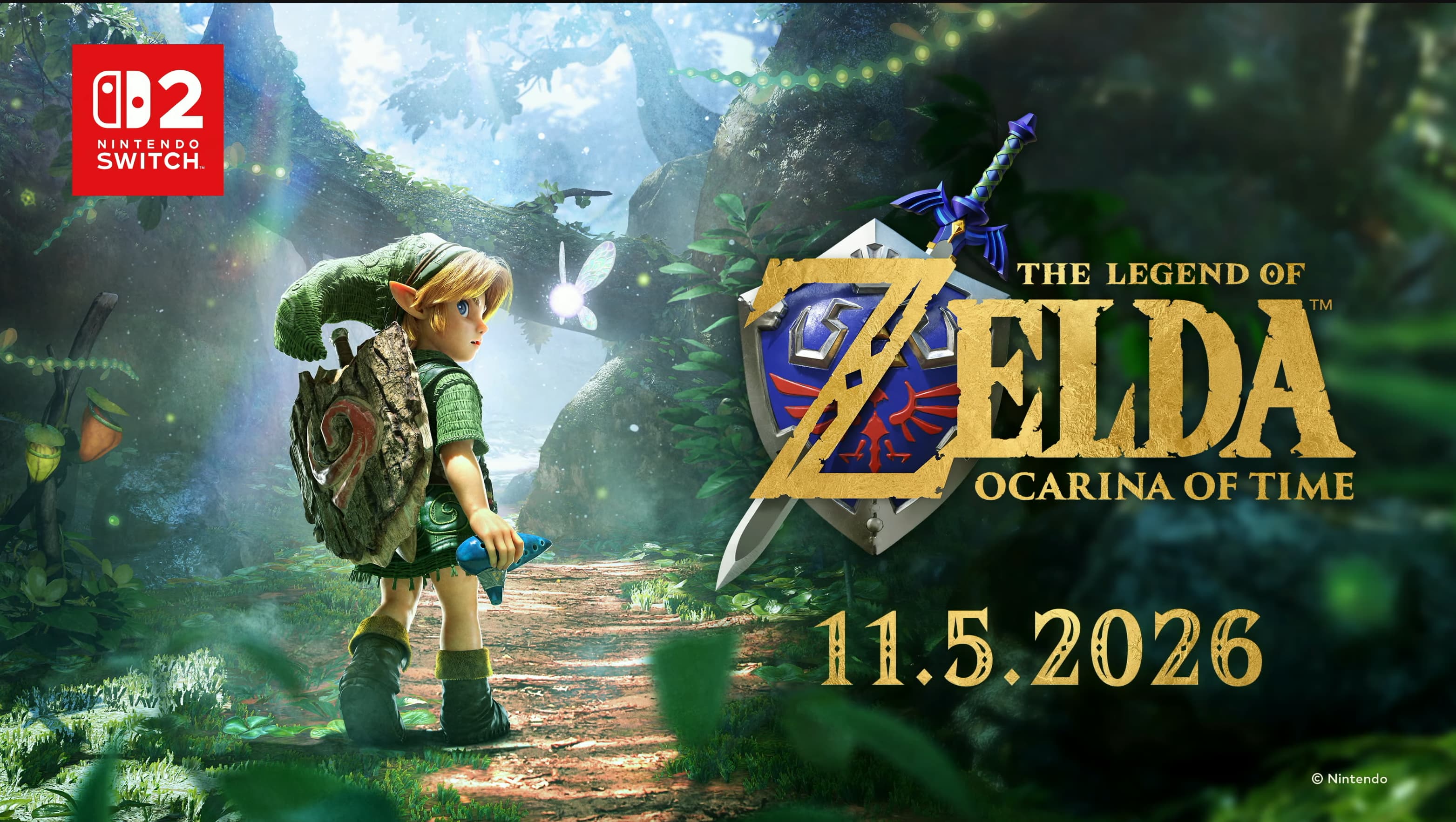
Nintendo has finally revealed details about one of the most anticipated productions among fans of the franchise. During the special Nintendo Direct celebrating the 40th anniversary of The Legend of Zelda, held on Tuesday, September 8, 2026, the company presented the first major gameplay footage of The Legend of Zelda: Ocarina of Time Remake, along with new products, accessories, experiences, and updates related to the series' cinematic future.
Expectations for the event were particularly high. After all, Ocarina of Time is not only one of the most important titles in Nintendo's history, but also one of the most influential games in the industry. Originally released in 1998 for the Nintendo 64, the game helped establish several concepts that would become fundamental to 3D action-adventure games.
The idea of imagining Ocarina of Time with modern graphics did not originate solely within Nintendo. For years, fans have created their own interpretations of the classic, and one of the best-known projects was developed by Giuseppe Macula, known online as CryZENx. The project began in 2015 using Unreal Engine 4 and later evolved to Unreal Engine 5, accumulating a decade's worth of demonstrations of Hyrule reconstructed in high definition.
CryZENx's project reached an impressive level of popularity within the community and helped fuel the exact fantasy many fans had: what would Ocarina of Time look like rebuilt with today's graphical technology?
Personally, it would be interesting to imagine what might have happened if CryZENx had received an opportunity to officially contribute to the project. There is no indication that this ever happened, but there is something symbolic about the story: for years, a fan showed the public the potential of a modern version of Ocarina of Time, and now Nintendo itself has decided to officially create this reinterpretation.
The Ocarina of Time Remake Finally Shows Its True Scale
The remake of The Legend of Zelda: Ocarina of Time had already been announced in June during a Nintendo Direct, but that first presentation served only as a brief preview. Now, Nintendo has shown much more of the project, making it clear that this is not simply a remaster.
The game has received a complete visual reconstruction, with new models, textures, lighting, redesigned environments, and a presentation much closer to modern standards. The approach is particularly interesting because Ocarina of Time was already aiming for a more realistic representation of Hyrule by Nintendo 64 standards. Decades later, the remake can finally take that idea much further.
This expectation also has a curious connection to Nintendo's own history. At E3 2011, the company presented a Zelda tech demo featuring an extremely realistic depiction of Link and Ganondorf, something that impressed fans and remained for years as a visual reference for imagining how the franchise could be presented with more realistic graphics.
Although that demonstration was not an announcement for an Ocarina of Time remake, it helped fuel an expectation that remained alive among some fans. Now, many years later, Ocarina of Time is finally receiving a visual reinterpretation capable of exploring that direction.
It is inevitable to compare this approach with Breath of the Wild and Tears of the Kingdom, which established their own artistic identity for the franchise. Both are visually impressive games with unique styles, but they follow a much more stylized direction.
The Ocarina of Time remake, on the other hand, appears to be pursuing an interpretation closer to realistic fantasy, something many fans hoped to see again in a major entry in the series.
Some images shown during the presentation are particularly striking, such as the interiors of Hyrule Castle and the region's open areas. The lighting, materials, and level of detail clearly demonstrate the technical potential of the Nintendo Switch 2.
Some critics may associate certain visual choices with the look of games developed using popular engines such as Unreal Engine. However, this comparison is not inherently a problem. Engines such as Unreal and Unity are widely used tools within the industry and do not, by themselves, determine the artistic identity of a production. The final result depends primarily on choices involving art direction, modeling, lighting, materials, and composition.
A Modern Ocarina of Time Without Abandoning Its Roots
Perhaps the greatest concern when remaking a classic of such importance is precisely how to modernize its structure without removing what made the original so special. And, based on what was presented, Nintendo appears to have adopted a fairly balanced strategy.
One of the most obvious changes is movement. In the original game, Link would automatically perform small jumps when reaching certain edges. Now, the player has a dedicated jump command, bringing the system closer to contemporary standards.
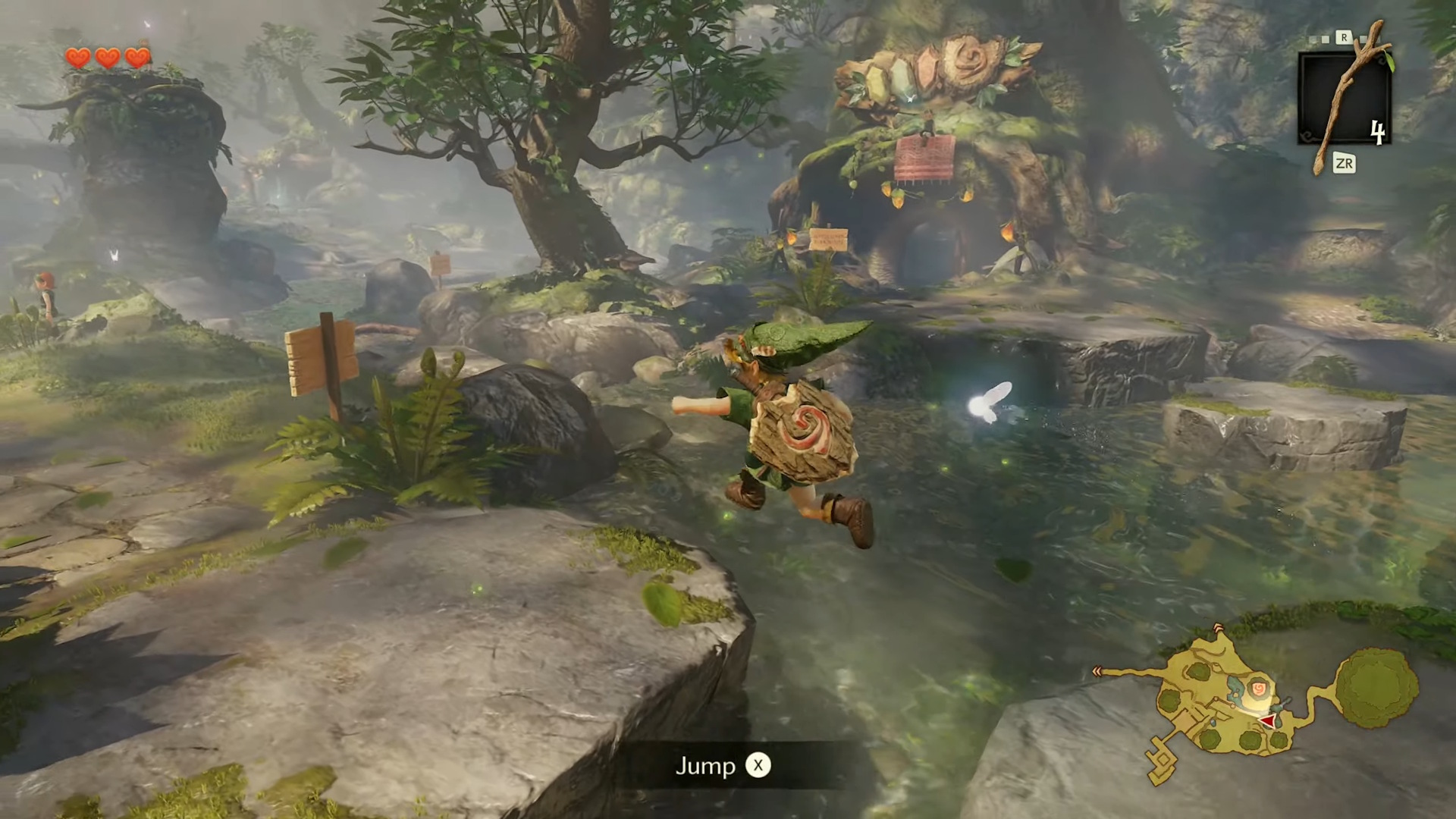
Movement has also gained a sprint option. Interestingly, Nintendo decided to retain the traditional roll used by Nintendo 64 players to move faster. In this way, the remake introduces a modern alternative without simply removing one of the most recognizable characteristics of the original experience.
The camera has also been completely modernized, allowing greater freedom of control using the right analog stick. This change may seem simple, but it represents an important evolution for a game whose movement was originally designed around the limitations and possibilities of the Nintendo 64.
Nintendo has also introduced improvements to other actions, including movement underwater and the aiming system, bringing the experience much closer to modern standards without stripping away the identity of the original adventure.
Interface, Lighting, and a Rebuilt Hyrule
Another aspect that received attention was the game's interface. Menus, item management, and navigation have been updated to more closely resemble the experience of modern entries in the franchise, making the overall functionality more intuitive.

The reconstruction of the environments also appears to be one of the project's greatest strengths. Nintendo has remodeled numerous locations, adding new details and allowing more dynamic exploration through the free camera.
Hyrule Castle Town, for example, is no longer subject to the same camera limitations as the original game and can now be explored with greater freedom. Characters and environments have also received more elaborate animations, giving the world much more life.
The lighting deserves special attention. The remake uses shadows, reflections, particles, and atmospheric effects to create a much more vibrant Hyrule. Elements such as fog and particles appear in different environments and help build a more cinematic atmosphere.

Naturally, this choice may divide opinions. For some fans, certain environments may appear more overloaded with effects than necessary. The Great Deku Tree, for example, featured interior sections during the demonstration that appeared quite dark.
This could simply be a characteristic of that specific section of the dungeon or even an issue related to the presentation, so it is too early to draw definitive conclusions. Still, it is a detail worth observing as new images and videos are released.
There is also an interesting difference in the passage of time. The remake features a continuous day-and-night cycle, including areas where this flow was previously interrupted, making Hyrule more dynamic and coherent.
The Ocarina Gets a New Form of Interaction
Among all the new features presented, one of the most curious is precisely the element that gives the game its name. The Ocarina of Time has gained a new layer of interaction through the microphone built into the Nintendo Switch 2.

Players will now be able to simply hum one of the melodies learned by Link and have the character play the song in the game. The system can also recognize instruments, and Nintendo has announced new physical Ocarinas to expand the experience.
The idea is interesting because it transforms one of Ocarina of Time's most traditional mechanics into an even more interactive experience. At the same time, there is also an obvious commercial opportunity: the company announced a playable Ocarina and an electronic version produced by HORI.
It is difficult not to see this decision as an excellent marketing strategy as well. After all, few elements of Zelda are as recognizable as the Ocarina itself. Turning this object into a real accessory capable of interacting with the game is a very creative way of bringing the physical product closer to the digital experience.
The soundtrack has also received an important update. The classic songs have been preserved, but now feature orchestral arrangements, reinforcing the epic atmosphere of the adventure without abandoning the musical identity that has defined generations of players.
Portuguese Voice Acting and a New Narrative Presentation
Another particularly important piece of news for Brazilian audiences was confirmed following the presentation: The Legend of Zelda: Ocarina of Time will feature Brazilian Portuguese voice acting.
The localization accompanies the remake's expanded narrative. Cutscenes now feature full voice acting, and characters have been given more extensive dialogue. Link, naturally, remains the silent protagonist, preserving a fundamental characteristic of the series.
For a game that originally featured a much more limited amount of spoken dialogue, this change represents a significant transformation in how the story will be presented to a new generation.
Threads of Time and New Tools for Exploring Hyrule
Another new feature is the Threads of Time system, created to help players keep track of their progress throughout the adventure. The tool allows players to check objectives and visualize the evolution of their journey through a large tapestry that is gradually filled in as the story progresses.
Nintendo will also expand the experience through ZELDA NOTES, a service integrated into the Nintendo Switch app. Features include daily adventure logs, statistics, location challenges, a virtual Ocarina, and a quiz with more than 2,000 questions about the game.
It is an interesting approach because it turns elements outside the game into part of the experience. Rather than simply reproducing Ocarina of Time, Nintendo appears to be trying to build a kind of ecosystem around the classic.
The Remake Arrives on Nintendo Switch 2 in November
After months of anticipation, Nintendo has finally confirmed the release date: The Legend of Zelda: Ocarina of Time will arrive on Nintendo Switch 2 on November 5, 2026.
The game will be sold digitally for US$59.99, while the physical version will feature a special launch edition with textured foil cover artwork, available while supplies last.
It is a small detail, but a particularly meaningful one at a time when the industry seems increasingly focused on digital distribution. For a commemorative game from such an important franchise, Nintendo demonstrates that there is still room to make the packaging itself part of the experience.
For a title that represents such an important part of Nintendo's history, investing in a special physical presentation seems like a wise decision. And there is also a curious coincidence: the game arrives in November, precisely during a period when the market will be heavily focused on the enormous hype surrounding GTA VI.
Personally, I'm Team Zelda. I still believe an even more powerful marketing strategy would have been to release the game in December, taking advantage of the Christmas season and the franchise's nostalgic appeal.
It would even be interesting to imagine an advertising campaign referencing the famous image of a child receiving a Nintendo 64 for Christmas. If it were possible to locate the person featured in that old advertisement, a new campaign showing that same person receiving the Ocarina of Time remake decades later would be an extremely powerful tribute to Nintendo's history and the emotional relationship its games have created with different generations.
40 Years of Zelda Also Means New Products
The celebration will not be limited to the game. Nintendo has announced a special Nintendo Switch 2 edition celebrating the 40th anniversary of The Legend of Zelda, accompanied by a Pro Controller and a new case, all featuring elements inspired by the Triforce.
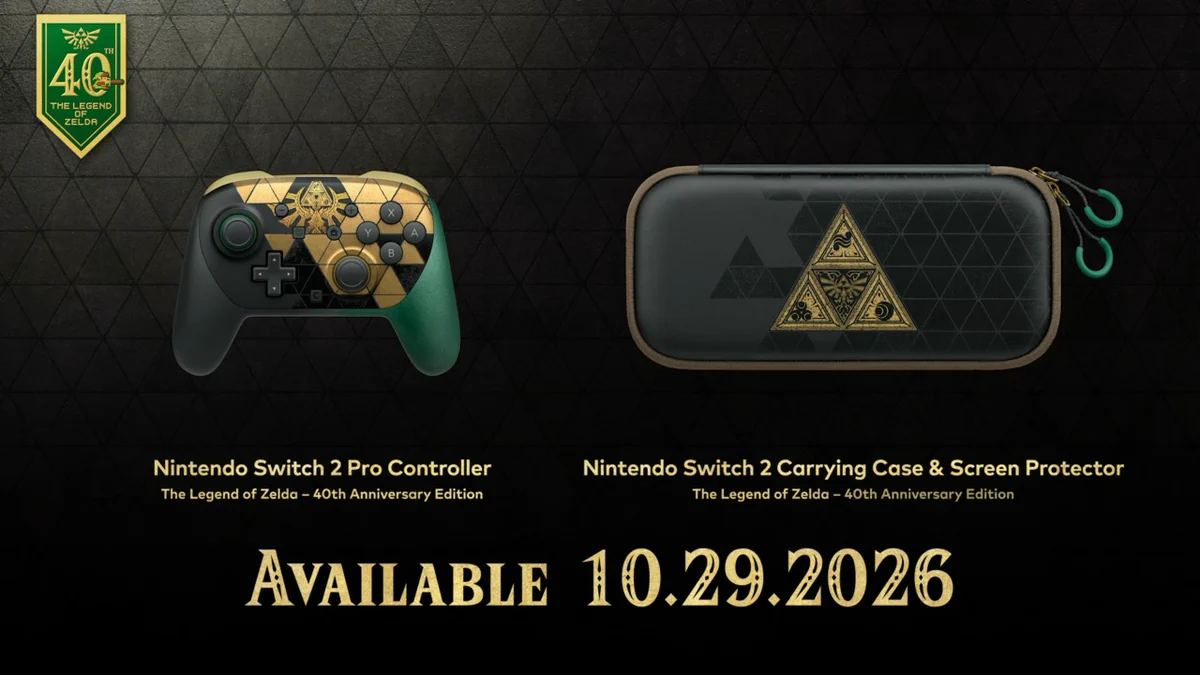
The commemorative console arrives on October 29, 2026, just a few days before the remake's release. The set uses the Triforce as its main visual element and will also include commemorative accessories.
New Young Link and Young Zelda amiibo have also been announced. They will arrive in 2027 and will be able to unlock special masks within the remake, inspired by the retro visual style of the original game.
The celebration will also include a series of The Legend of Zelda concerts around the world throughout 2027, as well as licensed products such as a large LEGO set based on Link and Epona and an electronic Master Sword produced by Hasbro.
The Zelda Movie Also Received Its First Major Spotlight
The Direct also made room for another highly anticipated project: the live-action The Legend of Zelda movie.
Nintendo officially confirmed that the film will simply be titled The Legend of Zelda. The production will tell an original story based on the ideas, concepts, and elements developed throughout the franchise's 40-year history.
The film is scheduled for a worldwide theatrical release on April 30, 2027. Although the presentation did not yet show a full trailer, the title announcement already represents an important step toward the cinematic adaptation.
The decision to simply use the name The Legend of Zelda is also curious. According to Shigeru Miyamoto, there is a reason for the absence of a subtitle, something that should make more sense once audiences become familiar with the project.
Ocarina of Time Could Be the Great Symbol of Zelda's 40th Anniversary
In the end, Nintendo seems to have understood exactly what fans expected from a celebration like this. Ocarina of Time is one of the most important games in the franchise's history and perhaps one of the few titles capable of simultaneously representing Zelda's past and future.
The original already impressed audiences in 1998 by transporting the series into a three-dimensional world and embracing a much more ambitious representation of Hyrule. Now, the remake uses the technology of the Nintendo Switch 2 to reinterpret that same vision with modern graphics, new controls, reconstructed environments, and features that would not have been possible at the time.
More important than simply improving the graphics, however, is the decision to preserve the elements that allowed the classic to remain relevant. The roll is still present, the music remains recognizable, the Ocarina remains at the center of the experience, and the original structure of the adventure continues to be respected.
Nintendo does not appear to be trying to replace the Ocarina of Time that players knew on the Nintendo 64. The goal is to present that same adventure to a new generation, using the tools available today.
And perhaps that is precisely what makes this remake so interesting. Breath of the Wild and Tears of the Kingdom proved that Zelda can take on new forms without losing its identity. Now, Ocarina of Time will have the opportunity to show how one of Nintendo's greatest classics can be reinterpreted for a modern audience.
The anticipation, therefore, is not only about the graphics. It is about discovering whether Nintendo can find the perfect balance between nostalgia and modernization. Manual jumping, sprinting, the free camera, the new interface, voice acting, the orchestral soundtrack, and interaction with the Ocarina show that the company does not intend to simply rebuild the original game with better textures.
If the final result manages to balance nostalgia, modernization, and respect for the original material, the remake could become not only one of the major celebrations of The Legend of Zelda's 40th anniversary, but also one of the most important titles in the early years of the Nintendo Switch 2.
After all, when it comes to Zelda and Mario, expectations surrounding Nintendo are always enormous. And there is a reason for that: few franchises in video game history have managed to turn every new release into a cultural event. Now, all that remains is to wait until November 5, 2026 to discover whether this new Ocarina of Time will live up to the legend.

Nenhum comentário:
Postar um comentário